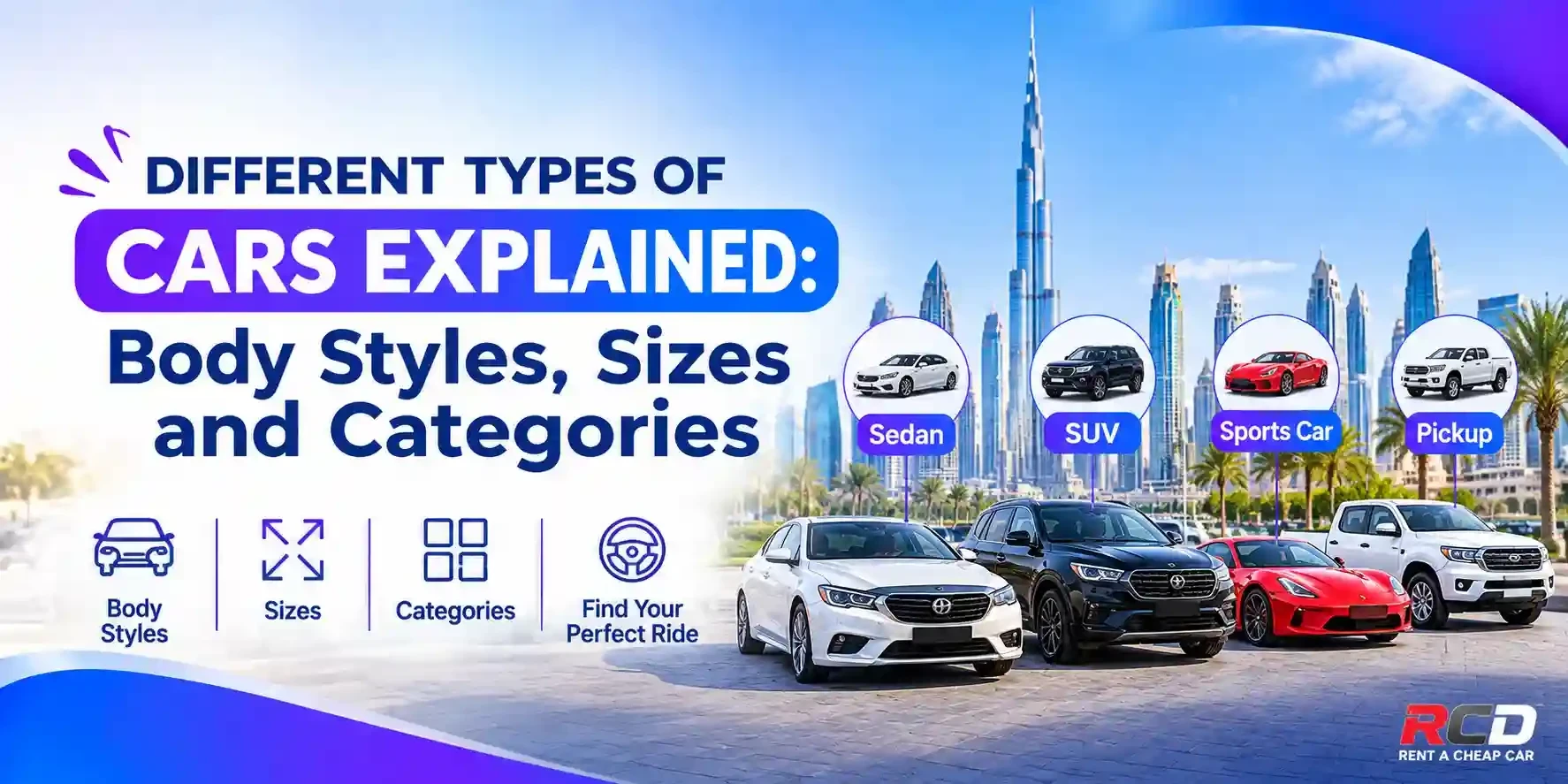
Different Types of Cars Explained: Body Styles, Sizes and Categories
What are the different types of cars? The main types of cars are sedans, hatchbacks, SUVs, crossovers, coupes, convertibles, station wagons, and pickup trucks.
When you know the design characteristics of various cars and what these cars offer, choosing a car becomes easier. Each vehicle type is used for different purposes. The type of car, the cabin space it offers, the engine, and how the car drives are all relevant to how the vehicle is used in everyday life. Anyone looking for their first car, an upgrade for their family car, or exploring the car market should know the different types of cars to compare options and make the best choice.
What are the Different Types of Cars?
Cars are generally categorized based on body shape, dimensions, uses, and power systems. The categories enable buyers to understand the differences in passenger capacity, luggage capacity, driving comfort and performance.
For instance, typically a sedan will have a dedicated boot and a comfortable, spacious cabin for passengers, whereas an SUV will have a higher driving position and increased ground clearance. Similarly, electric cars are not named for the way they look.
It's especially helpful when buying a car on GreatDubai's car marketplace and comparing the various car models and vehicle categories.
Different Types of Car Body Styles
Car body styles refer to the outside appearance, structure, and overall design of the car. These are the most popular types of vehicles currently on the market.
Sedan
A sedan is a passenger car with four doors, a separate passenger cabin and an enclosed boot. It typically offers good seating, good roadability and moderate luggage capacity.
- Benefits: Good ride, ample seating and convenient boot space.
- Ideal for: Everyday commuters, business trips and small families.
- Examples: Toyota Camry, Honda Accord and Nissan Altima.
Hatchback
A hatchback is a car with an upper-opening rear door, which is designed to open upwards together with the rear window. Its small size makes it easy to drive in the city, narrow spaces, and everyday driving.
- Benefits: Parking ease, convenient load access and overall relatively low running costs.
- Ideal for: Students, individuals, couples and urban commuters.
- Examples: Suzuki Swift, Kia Picanto and Volkswagen Golf.
SUV (Sport Utility Vehicle)
An SUV is a vehicle renowned for its increased ground clearance, a higher seating position, and roomy cabin. They can have two or three rows of seats, and can be either two-wheel or four-wheel drive.
- Benefits: Better visibility and cabin space on the roads as well as availability of off-road facilities.
- Ideal for: Families, long trips and drivers wanting extra passenger or trunk space.
- Examples: Toyota Land Cruiser, Nissan Patrol and Toyota Prado.
Crossover
A crossover is a combination of the styling and elevated seating position of an SUV with the platform and characteristics of a conventional passenger car. Manufacturers intend the majority of crossovers to be driven comfortably, not in the off-road environment.
- Benefits: Well-balanced fuel efficiency, good handling and utilitarian cabins.
- Ideal for: Small families, urban dwellers and those who desire to have the look of an SUV without the size.
- Examples: Toyota RAV4, Honda CR-V and Nissan X-Trail.
Coupe
A coupe is a car with two doors and a sporty, sloping line to the rear. Modern manufacturers also use it for some 4-door cars that share the design.
- Benefits: Sporty look, responsive performance and unique design.
- Ideal for: Drivers who appreciate style and driving fun.
- Examples: BMW 4 Series Coupe, Ford Mustang and Mercedes-Benz CLE Coupe.
Convertible
A convertible is a car equipped with a folding roof, which lets the driver enjoy open-air driving. The roof can be made of fabric or a fold-down hard top.
- Benefits: Outdoor experience, stylish and fun leisure driving.
- Ideal for: Couple, enthusiast/ recreational driving.
- Examples: Mazda MX-5, BMW Z4 and Porsche 911 Cabriolet.
Station Wagon
Also known as an estate car, a station wagon is a vehicle with a longer roofline and a longer rear cargo area. It boasts a capacity that is greater than many conventional sedans and a relatively low driving seat.
- Benefits: spacious luggage compartment, convenient seating for occupants, convenient loading area.
- Ideal for: Families, road trips and frequently traveling with luggage.
- Examples: Volvo V90, Audi A6 Avant and BMW 5 Series Touring.
Pickup Truck
A pickup truck is a vehicle with a closed passenger compartment and an open truck bed at the back. They are built to carry heavy loads, such as equipment, construction materials, and more.
- Benefits: Cargo-carrying ability, durable construction and availability of four-wheel drive.
- Ideal for: Businesses, outdoor activities, construction work and off-road driving.
- Examples: Toyota Hilux, Ford Ranger and Nissan Navara.
MPV and Minivan
An MPV (Multi-purpose vehicle) is a vehicle that focuses on passenger space, flexibility of seating and interior usability. Several models have seating for 7 or 8 people; they are great for bigger families.
- Benefits: Large cabins, many seating options and convenient access for passengers.
- Ideal for: Big families, group transportation and commercial passenger services.
- Examples: Kia Carnival, Toyota Sienna and Honda Odyssey.
Types of Cars Based on Vehicle Sizes
Vehicles are categorized by size, with the exception of body shapes. They are used to categorize the capacity of passengers, interior dimensions, parking convenience, and overall practicality. To fill the search intent gap, we have included the European size segments used globally.
|
Vehicle size |
Euro Segment |
Main characteristics |
Popular examples |
|
Mini / Micro |
A-Segment |
Very compact, usually two to four seats |
Smart Fortwo |
|
Subcompact |
B-Segment |
Small body, practical city driving |
Kia Picanto, Suzuki Swift |
|
Compact |
C-Segment |
Balanced passenger and luggage space |
Toyota Corolla, Honda Civic |
|
Midsize |
D-Segment |
More cabin space and comfort |
Toyota Camry, Honda Accord |
|
Full-size |
E/F-Segment |
Larger dimensions and spacious interiors |
Mercedes-Benz S-Class |
|
Large SUV |
J-Segment |
High ground clearance and generous cabin space |
Nissan Patrol, Toyota Land Cruiser |
How Do Vehicle Sizes Affect Your Choice?
Generally, smaller vehicles are easier to park and drive in busy urban areas. Compact cars and midsize cars are perfect for everyday functionality and passenger comfort.
Full-size vehicles and large SUVs offer more room inside, but might need more space for parking and higher operating expenses. The decision should be made based on the number of passengers, driving conditions, and the available budget.
Different Types of Vehicles Based on Purpose
Not all vehicles can be driven the same way. Some are geared towards passenger comfort, others towards speed, cargo capacity or special transportation.
|
Vehicle category |
Main purpose |
Examples |
|
Economy cars |
Affordable everyday transportation |
Nissan Sunny, Kia Picanto |
|
Family cars |
Passenger comfort and safety |
Toyota Camry, Honda CR-V |
|
Luxury cars |
Premium comfort and advanced features |
Mercedes-Benz S-Class, BMW 7 Series |
|
Sports cars |
Speed, acceleration and performance |
Porsche 911, Chevrolet Corvette |
|
Off-road vehicles |
Driving on rough and uneven terrain |
Jeep Wrangler, Toyota Land Cruiser |
|
Commercial vehicles |
Transporting passengers or goods |
Ford Transit, Toyota Hiace |
|
Supercars |
High-performance driving and engineering |
Ferrari 296, Lamborghini Huracán |
Some categories can overlap. An example is that a luxury SUV can be used for a family vehicle, and a pickup truck can be used for both commercial and recreational purposes.
Different Types of Cars Based on Fuel and Powertrain
Another key method of understanding the types of vehicles is to explore how they produce power. The fuel and powertrain technologies of modern vehicles vary in response to performance, efficiency, and the environment.
Petrol Cars
Petrol vehicles use internal combustion engines with gasoline. They are plentiful and you can refuel them at existing fuel stations. These include the Toyota Corolla, Nissan Sunny and Honda Civic.
Diesel Cars
Diesel vehicles use compression-ignition engines. Buyers commonly choose them for their torque and ability to handle tough driving environments. You can commonly find them in pickups, commercial vehicles and larger SUVs. These range from the Toyota Hilux diesel and certain Land Cruiser diesel models.
Hybrid Cars
Hybrid cars run on a hybrid system of a petrol engine and an electric motor and battery. The system can optimize fuel consumption, especially in transient driving situations. These are vehicles like the Toyota Prius, Toyota Camry Hybrid, and Toyota RAV4 Hybrid.
Plug-in Hybrid Electric Vehicles (PHEV)
PHEVs mix a petrol engine and a rechargeable battery that can run the vehicle for shorter distances. You can charge them with an external energy supply, unlike traditional hybrids. Some examples are the Mitsubishi Outlander PHEV and BYD Sealion 6 DM-i.
Electric Vehicles (EVs)
EVs use battery-powered electric motors rather than traditional petrol or diesel engines. They do not emit any tailpipe pollution, and they need proper charging stations. Some examples are Tesla Model 3, BYD Atto 3 and Hyundai IONIQ 5.
Hydrogen Fuel Cell Vehicles
These vehicles produce power as a result of a chemical reaction between hydrogen and oxygen. They emit water vapour from the vehicle's tailpipe and need a special hydrogen fueling station. Examples are the Toyota Mirai and Hyundai NEXO.
Which Type of Car is Best for Different Driving Needs?
The best car choice will be based on how often you drive, how many passengers you carry, and driving conditions.
- City driving: Smaller cars, hatchbacks and compact sedans are helpful due to their smaller size and ease of parking.
- Family transportation: SUVs, crossovers and MPVs provide extra seats and space.
- Business travel: Sedans and luxury cars offer a level of comfort and professionalism that is ideal for business travel.
- Off-road trips: 4WD SUVs and appropriate pickup trucks have more capabilities in muddy terrain.
- Long-distance driving: Comfortable sedans, crossovers and SUVs offer a good balance for passenger space and driving comfort.
- Lower emissions transport: Consider hybrid and electric vehicles where feasible and practical, depending on access to charging and driving patterns.
How to Choose the Right Car Type Before Buying?
It's not just a question of appearance or brand when picking your vehicle. Before buying, take these into account:
- Budget: Review the cost of buying, insurance, fuel, maintenance, and registration costs.
- Passenger capacity: Ensure your vehicle has enough space for your regular passengers.
- Fuel efficiency: Consider petrol, diesel, hybrid or electric options based on your daily driving distance.
- Driving conditions: Consider road traffic, motorways, parking and off-road needs when driving.
- Safety ratings: Review crash test safety scores from organizations like Euro NCAP to ensure passenger safety.
- Maintenance and resale value: Investigate the availability of spares, costs of service and future resale potential.
If you're looking to buy a used car, check out our Great Dubai used-car buying guide so you will be familiar with what you should check out and the vehicle inspection process and service records.
Final Thoughts
If you know the various types of cars, then it becomes simpler to choose a car. Whether you are looking for a budget-friendly city car, a spacious family SUV, a luxury sedan, or an EV, there are distinct benefits to each body style, size, and powertrain. Don't make a decision based solely on looks; check passenger capacity, running costs, maintenance, and driving conditions. When you are considering buying a vehicle, it is important to look through various categories to find a car that will accommodate your lifestyle, practical requirements and budget.